
Oral care at home
Preparing for and recovering from wisdom tooth removal
Preparing for wisdom tooth removal, care in the first 24 hours, eating and cleaning over the following days, and the warning signs that mean you should call.
· 4 min read ·

General dental health
The signs of an impacted wisdom tooth, when a dentist advises removal and when watching is better, what the X-ray shows and when to come in urgently.

Wisdom teeth are the last to come through, usually between eighteen and twenty-five, when the jaw has almost run out of room. That is why they so often come through at an angle, stay buried, or only partly emerge, causing pain, swelling and damage to the tooth in front. Not every wisdom tooth has to be removed, but you should not wait for severe pain before having it checked.
Wisdom teeth are the third molars, one in each corner of the mouth, four at most. Many people are missing one or more from birth, or have them buried in the bone where they never erupt. A wisdom tooth that comes through straight, with enough room, and can be cleaned can be kept like any other tooth.
Many impacted wisdom teeth cause no symptoms for years and are only found on an X-ray, by which time the second molar in front has already decayed or its root has been resorbed.
Removing or keeping is a weighing of benefit against risk for each individual tooth; there is no rule that fits everyone.
Looking in the mouth only shows the part of the tooth that has emerged. A panoramic X-ray shows which way the tooth lies, whether the roots are curved or straight, how close it is to the nerve canal in the lower jaw or the sinus in the upper, whether there is a cyst, and whether the second molar is affected. For teeth close to the nerve the dentist may take a cone-beam CT scan to plan a safer removal. So if you are at the age when wisdom teeth come through, one check-up X-ray is reasonable even without pain.
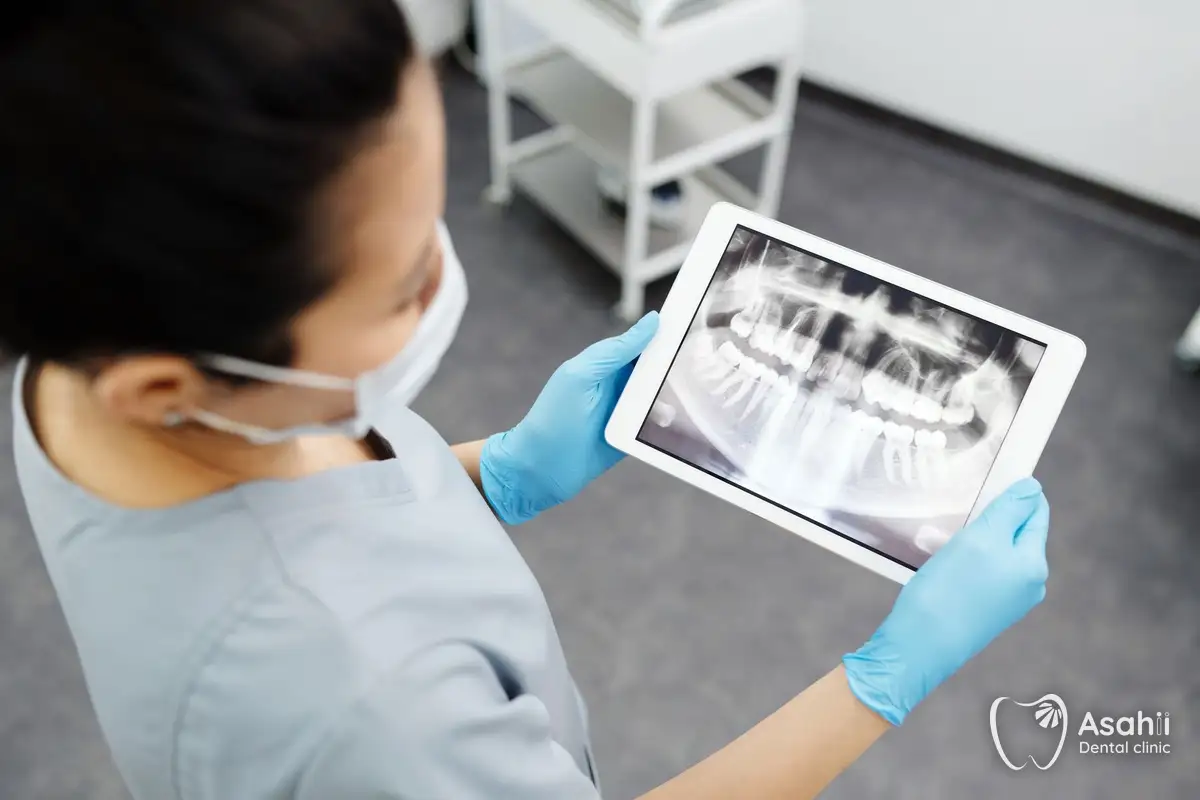
Wisdom tooth removal is a minor procedure under local anaesthetic. A tooth that has come through straight can be removed quickly; a buried one needs the gum opened and sometimes the tooth divided to take it out. Afterwards there is usually swelling and soreness for a few days, and some care is needed. At Asahii, wisdom tooth surgery is carried out by Dr. Tran Van Thang, the clinic's oral surgeon; for a tooth close to the nerve canal he plans the removal on a cone-beam CT scan and explains the risks, the options and the cost to you beforehand, so you agree before a date is set. See Preparing for and recovering from wisdom tooth removal.

These can mean the infection is spreading and needs early treatment. Only an examination and X-rays can tell whether your wisdom tooth should be removed or watched. See our general dentistry page or book an appointment by hotline 0928 888 121, Zalo or the Mini App; the clinic is open every day of the week, 08:30 to 19:00, so a flare-up at the weekend does not have to wait.
Not necessarily. A straight tooth that can be cleaned can be kept. A tilted tooth can damage the tooth in front even without pain, so an X-ray is needed for the dentist to decide.
Lower wisdom teeth lie close to the nerve canal, so in some cases there is a risk of temporary numbness of the lip or chin after removal. The dentist assesses the X-ray beforehand to choose the approach and reduce that risk.
During an acute infection with swelling and pus, the dentist usually cleans the area and prescribes medicine to settle it before removing the tooth, because the anaesthetic works less well and the risk of spreading infection is higher. It depends on the case.
It is usually easier when you are young, before the roots are fully formed and while the bone is softer, with faster healing. Older adults can still have them removed; it just needs a more careful assessment.
This article is general information reviewed by our dentist; it is not a diagnosis. Only an examination can say what your teeth need.
Tap a star — 1 is not helpful, 5 is very helpful.
Thank you! Your rating helps us write better.
Could not send right now — please try again later.Leave your number — reception calls back to agree a time. The dentist explains and quotes before any treatment.
Preparing for wisdom tooth removal, care in the first 24 hours, eating and cleaning over the following days, and the warning signs that mean you should call.
· 4 min read ·

Why toothache gets worse at night, the common causes, safe ways to get through the night, what not to do, and when it is an emergency.
· 4 min read ·

Bleeding when you brush is a sign of gingivitis. How it differs from periodontitis, how to clean properly, the role of scaling and when to see a dentist.
· 4 min read ·
Book a visit
Leave your phone number – our front desk will call you back to find a time that suits you.