Asahii Dental clinic
+84 928 888 121 Book a visit

Crowns & cosmetic dentistry

Porcelain crowns: when you need one, and when you should not

When a porcelain crown really helps, when a filling, veneer or braces are better, the crown procedure step by step, and how to care for a crowned tooth.

The dentist uses a shade guide to match the colour of a crown to the patient's teeth

A porcelain crown is a cap that covers the whole of a tooth after it has been trimmed down. It is a very useful way to restore a tooth that is weak, badly broken or root-treated. But crowning is also irreversible: the enamel that is removed does not grow back. So the important question is not "which type of crown" but "does this tooth really need one".

When a crown helps

  • A root-treated tooth, especially a back tooth: a tooth without its pulp is more brittle and can crack under chewing; a crown protects it. See What is root canal treatment?.
  • A badly broken or heavily decayed tooth without enough structure left to hold a solid filling.
  • A cracked tooth that hurts when biting.
  • Severe wear from grinding or acid, where the height of the tooth needs rebuilding.
  • A single badly discoloured tooth (after injury or root treatment) that whitening does not improve.
  • A support for a bridge or a tooth on an implant.
  • An abnormally shaped tooth where more conservative options are not enough.

When to consider something else

  • A healthy tooth that is just a little yellow: whitening, or scaling and polishing, is usually enough. See Teeth whitening.
  • Crooked, protruding or crowded teeth: crowns cannot correct the bite and would mean trimming many healthy teeth; braces are the more conservative route, even if slower.
  • Small gaps or chips on front teeth: composite bonding or porcelain veneers keep far more of the natural tooth. See Veneers and crowns: what is the difference?.
  • Children and teenagers: the pulp is still large and the teeth still erupting; crowns are usually postponed.
  • Teeth with gum inflammation or gum disease: this must be treated first, or the crown margin will soon be exposed.
  • "Whitening the whole mouth" by crowning many healthy teeth: think very carefully. Trimming many healthy teeth in exchange for colour is a big trade-off, and crowns also need replacing after many years.

Because trimming a tooth cannot be undone, Asahii Dental Clinic keeps the decision transparent: the doctor explains your situation in detail, sets the options side by side (a filling, an inlay or onlay, a veneer, braces or a crown) and gives clear prices before anything is done; the plan is written down item by item with its costs, and you confirm it before the tooth is prepared.

The crown procedure

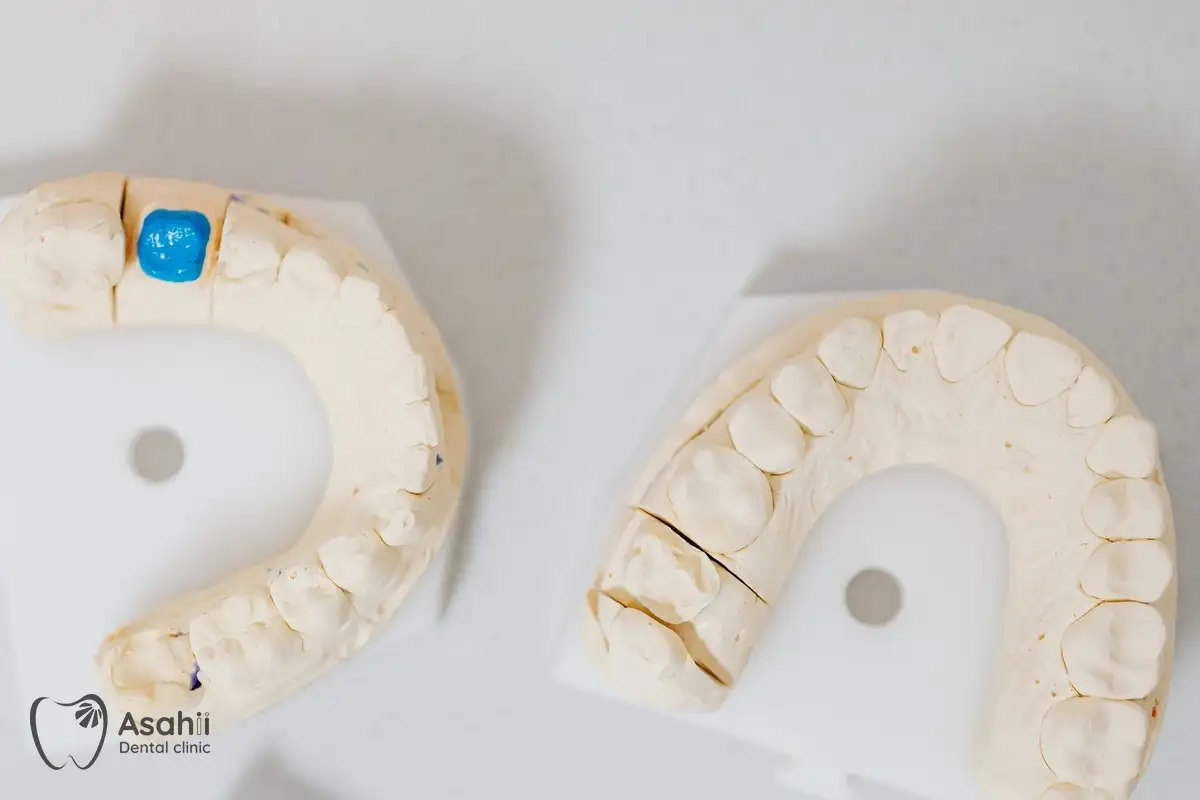
Plaster models from dental impressions, used by the lab to make crowns that fit the prepared teeth
  1. Examination and X-rays: checking the pulp, the root and the bone around the tooth. Root canal treatment or gum treatment comes first where needed.
  2. Choosing the material and shade: all-ceramic (zirconia, lithium disilicate) or porcelain fused to metal, depending on position, chewing load and appearance. The shade is matched to the neighbouring teeth. The ceramics Asahii works with are Emax, Lava Esthetics, Katana and zirconia; for a back tooth with moderate damage, an inlay or onlay removes less tooth than a crown.
  3. Anaesthetic and preparation: a layer is trimmed around the tooth to make room for the crown. An impression or digital scan is taken.
  4. Temporary crown: protects the prepared tooth while the crown is made.
  5. Try-in and cementing: fit, bite and shade are checked, then the crown is bonded with a dedicated cement. A small adjustment may be needed a few days later.

Caring for a crowned tooth

Brushing every day keeps crowns and the gums around them healthy for longer
  • Brush and clean between the teeth as for a natural tooth, paying attention to the margin where the crown meets the tooth: this is where decay can start again if plaque collects.
  • Avoid biting hard objects (ice, nuts, bottle caps) and do not use crowned front teeth to tear packaging.
  • Wear a night guard if you grind your teeth.
  • Attend check-ups so the dentist can inspect the margin and the gum, and take X-rays when needed.
  • Porcelain does not change colour with whitening, so if you want to whiten your other teeth, do it before the crown so the shades can be matched.

When to see us straight away

  • A crowned tooth that aches, stays sensitive or hurts when chewing.
  • A crown that is loose, has come off or is chipped.
  • Swollen, bleeding or smelly gums around the crown.
  • A dark line or a gap appearing between the crown and the gum.

Whether your tooth needs a crown can only be decided after a doctor has examined you and looked at the X-rays. See our cosmetic dentistry page or book an examination by hotline 0928 888 121, Zalo or the Mini App.

Frequently asked questions

Does a crown always mean a root canal first?

No. A tooth with a healthy pulp is usually crowned with the pulp kept alive. Root canal treatment comes first only when the pulp is inflamed, decay has reached it, or so much trimming is needed that it cannot be avoided. The dentist decides after an examination and X-rays.

How long does a porcelain crown last?

Many years with good hygiene, regular check-ups and no biting of hard objects. Its lifespan depends on the tooth underneath, the gums, the chewing load and your care, so nobody can promise a fixed number of years.

Will a crown give me bad breath?

A well-fitting, well-cleaned crown does not. Bad breath after crowning usually means an open margin, gum inflammation or trapped food, and needs checking.

My teeth are yellow. Should I crown the whole arch?

For healthy teeth that are only discoloured, whitening is far more conservative. Crowning many healthy teeth is a major decision that needs careful advice about the benefits and the long-term cost.

This article is general information reviewed by our dentist; it is not a diagnosis. Only an examination can say what your teeth need.

Was this article helpful?

Tap a star — 1 is not helpful, 5 is very helpful.

Share: Facebook Email

Considering cosmetic dentistry?

Leave your number — reception calls back to agree a time. The dentist explains and quotes before any treatment.

Read next

A bright, even smile: whitening suits healthy teeth that have become stained
Crowns & cosmetic dentistry

Teeth whitening: who it suits and what to know first

Who teeth whitening works for, why teeth discolour, in-clinic versus at-home whitening, who should not whiten, sensitivity afterwards and keeping the result.

· 4 min read ·

Book a visit

Book a cosmetic dentistry consultation

Leave your phone number – our front desk will call you back to find a time that suits you.

Request an appointment

Our front desk will call you back to find a suitable time. Your details are protected under our privacy policy.